

Slicer Infill Records: Combined Layers and Solid Intervals
2026-11-05
Slicer Infill Records: Combined Layers and Solid Intervals
Slicer Infill Records should distinguish combining infill across layers from requesting a periodic solid layer. The two features can both be labelled with a number of layers, making a shortened settings table ambiguous. Their documented roles are different. This article reads PrusaSlicer material for a fictional manufacturing appendix. It changes no project, produces no toolpath and prints no object; the aim is to identify which feature a supplied description means.
Locate the combined-infill feature
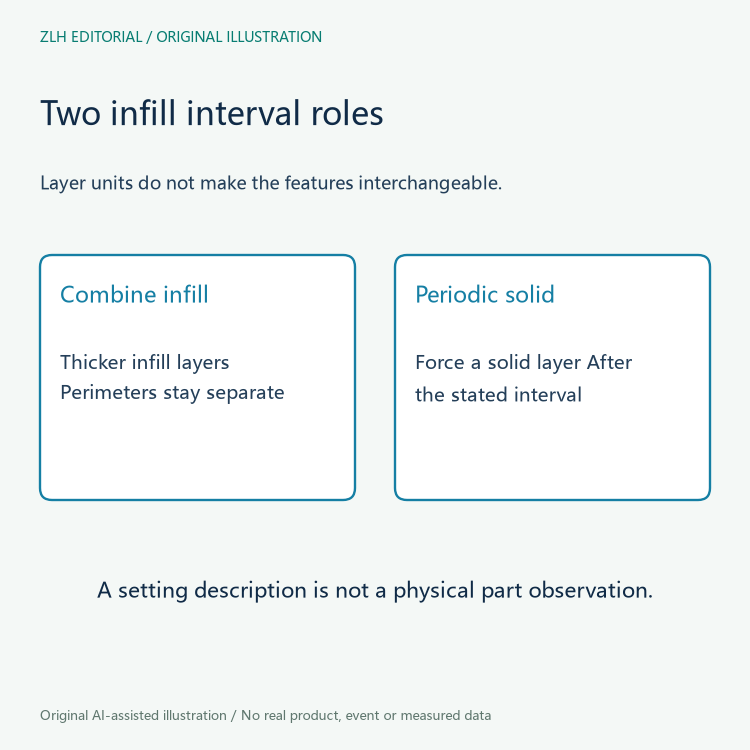
The official Prusa Infill article describes Combine infill every X layers through different layer heights for infill and perimeters. The infill can be combined into thicker layers while the perimeter context remains separate. A summary should retain this relationship rather than simply saying that the whole object's layer height was changed.
The article also identifies a nozzle-related limit on combined layer height. That qualification matters to a description of the feature. A documented interval alone is not proof that an unknown project produced a particular combined layer arrangement. This reading supplies no nozzle choice, layer-height value or recommendation for an actual print.
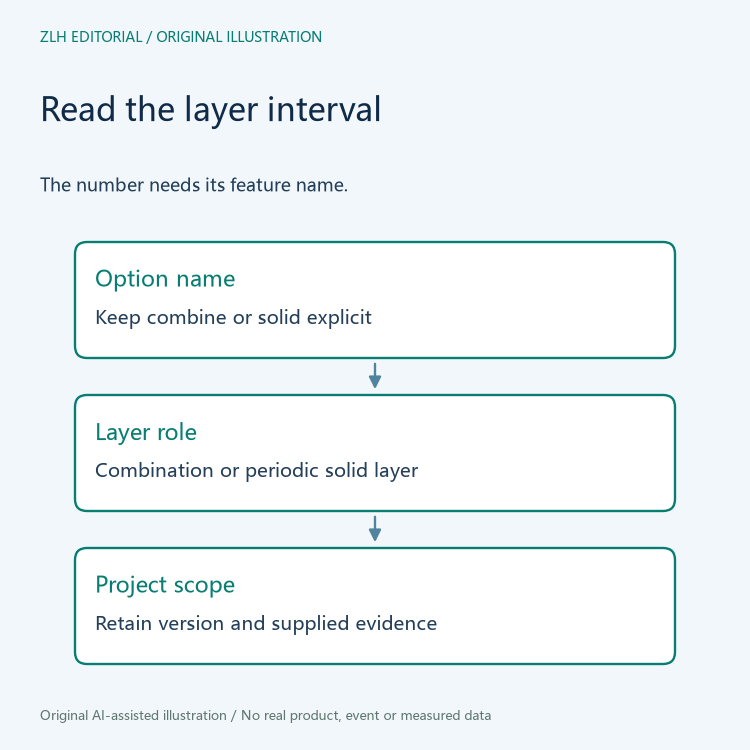
For a fictional handover, suppose a table has a field called every few layers. The editor should ask whether the source label was Combine infill every. If so, the note can describe the intended infill combination while leaving the applicable project evidence attached. A loose interval label would hide what is being combined and encourage readers to apply the statement to every feature in the model.
Read periodic solid infill as a different request
The same article describes Solid Infill every X layers as forcing a solid layer after a specified number of layers. This is a different role from combining sparse infill into thicker layers. Preserving the word solid is therefore necessary when a project setting is copied into a manufacturing brief.
Imagine a fictional appendix that renames a periodic solid-infill entry combine infill. A useful correction restores the original setting name and explains its role. It should not claim that the object was rebuilt or that the printed part became stronger. The documentation discusses purposes and conditions; no physical result has been observed for the fictional project.
The feature's description also should not be broadened into a statement that the entire object is solid. A periodic request concerns the documented layer arrangement. Whether an actual prepared job contains the claimed regions needs the applicable project and its generated evidence. A single feature label is not a complete internal-structure description.
Use the source definitions to preserve the two names
The official PrusaSlicer version 2.9.4 configuration definitions keep infill_every_layers and solid_infill_every_layers as separate options. Their labels and descriptions distinguish thicker combined infill layers from a forced periodic solid layer. These definitions provide a traceable connection between a setting name and its documented purpose.
The knowledge-base page sits in a PrusaSlicer 2.9 legacy topic context and also discusses automatic infill combination. The source-code reference here is a fixed 2.9.4 version. An editor should not merge every similarly named option into one unversioned control. A supplied project needs its applicable version and actual feature name before the public descriptions are attached to it.
Do not replace project evidence with the feature explanation
A settings account describes what was specified. A preview describes prepared software output, and a retained observation of a part concerns another evidence object. The contributor should identify which of these was supplied. This article does not open a project or inspect a preview, so it cannot establish which layers an actual slicer generated.
If the contributor revises the interval, keep the setting identity beside the changed entry. If only an ambiguous heading was repaired, describe that as a documentation correction. These two changes should remain distinguishable because one may concern project preparation while the other clarifies how existing material was summarized.
For a reviewer receiving several settings extracts, the surrounding section is useful evidence too. Preserve whether the entry came from infill controls rather than a general object-layer description. This does not require the reviewer to choose a value or generate a job. It makes the contributor's own account easier to trace and helps prevent the same number from acquiring a different meaning when copied into a shorter table.
Write the interval with its intended operation
A clear manufacturing appendix keeps the complete option name, its applicable version and the project relationship. A phrase such as infill combination interval answers a different question from periodic solid-layer interval. Both can appear in the same document without being interchangeable, and a shared unit of layers does not make them a single feature.
The original diagrams contain no real layer numbers, generated paths or measured material properties. Related reading appears in the 3D manufacturing documentation category and slicer reference category. Slicer Infill Records remain understandable when the operation is preserved with the interval, leaving actual prepared geometry and physical results to their own evidence.


