

Additive Model Base Color FAQ: Read Factor and Texture
2026-11-05
Additive Model Base Color FAQ: Read Factor and Texture
The base color of a glTF model in an additive-manufacturing briefing needs more context than the name of an image file. A material can combine a factor and a texture, and the resulting digital description remains separate from the appearance of a manufactured part. This FAQ reads Khronos documentation using a hypothetical briefing asset. It does not render a model, inspect a printed sample, measure color or establish a match between a preview and any physical material.
Where does the base color factor belong?
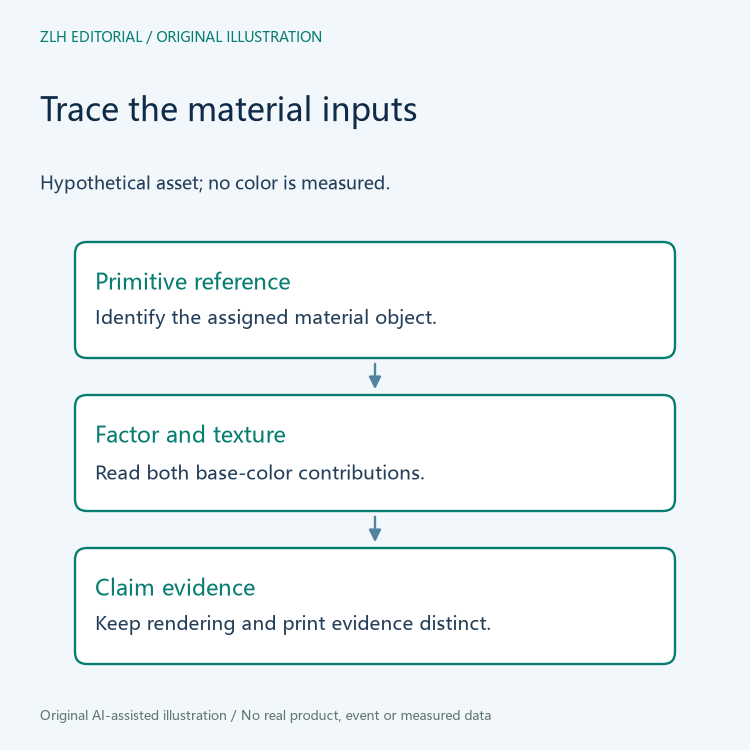
The Khronos simple-material tutorial places baseColorFactor inside the pbrMetallicRoughness material object and explains its red, green, blue and alpha components. It also shows that a mesh primitive refers to the material by its index. These relationships matter when an editorial excerpt contains several materials or a preview with multiple objects. A factor elsewhere in the file is not automatically the factor used by the pictured primitive.
In the hypothetical additive pack, trace the primitive-to-material reference before describing its fields. Retain the exact material definition and the relevant asset revision. Do not choose a value solely because its name resembles a part label. The review needs the explicit relationship connecting the displayed object to the material being discussed, rather than a visually plausible guess from a list of color values.
Does a texture replace the factor?
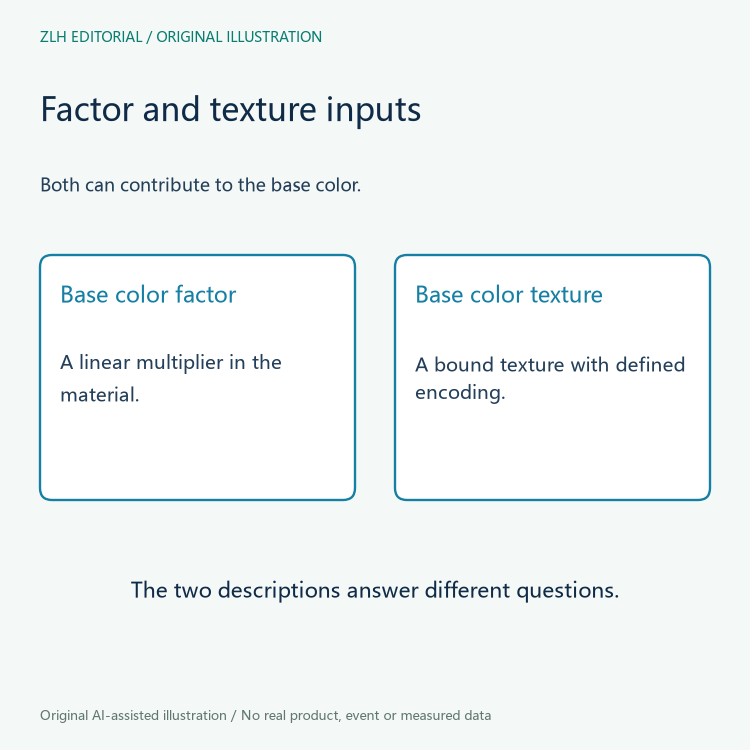
The glTF 2.0 specification explains that metallic-roughness properties may be defined with factors and textures. When both are supplied, the factor acts as a linear multiplier for the corresponding texture values. When a texture is absent, the relevant texture components are assumed to be one. These rules should remain part of the explanation instead of presenting factor and texture as competing alternatives in every case.
For the hypothetical model review, retain both definitions when both are present. An image file alone does not describe the entire base-color input, and a factor excerpt alone may omit a texture contribution. If the documentation pack supplies only one of those pieces, identify the missing context. This FAQ has not sampled a texture or calculated an output color; its diagrams show which objects a reviewer needs to connect.
Why must the texture binding and encoding remain visible?
The specification describes a texture binding through a texture index and an optional texture-coordinate index. It also requires base-color texture RGB values to be decoded from their sRGB encoding to linear values before computation. A useful explanation therefore keeps the binding and color-encoding rule with the material data. Multiplying raw encoded channel values without that context would not describe the stated model correctly.
A hypothetical briefing author should ask which texture resource and coordinates the asset references, then preserve the accompanying interpretation. This is a reading task, not a request to execute a renderer or adjust a printer. A diagram of the material relationship should not use invented sampled values or a measured-looking color comparison. When actual rendering evidence is supplied, record its environment and source asset rather than substituting a hand-drawn swatch for an observation.
Can another input or renderer context affect the explanation?
The specification notes that a primitive's COLOR_0 vertex color, when present, is an additional linear multiplier to base color. It also explains that implementations of the reflectance function may vary with device performance and resource constraints. A local material excerpt is thus not a complete guarantee of identical rendered pixels across every application. State the model and rendering context actually documented instead of claiming a universal preview result.
Suppose a hypothetical pack is revised and a texture or vertex-color definition changes. Retain the two asset versions and the provider's explanation of the change. Do not infer that a physical part was recolored or that a printer process changed. A digital asset revision can be documented as such while the manufacturing record remains a separate source of evidence.
What does a rendered material say about a printed part?
The inspected documents define a digital material representation. They do not establish a printer's color capability, a feedstock formulation, surface finish or a measured match to the displayed model. In an additive briefing, any statement about the manufactured part needs its own relevant process and observation record. A familiar material name or an attractive preview should not silently take the place of that evidence.
A precise review note names the glTF version, primitive and material reference, factor, texture binding and any relevant vertex-color input. It then states which part of the rendering or manufacturing claim has actual supporting material. This creates a concrete question for the provider without awarding a compatibility or color-match assurance from source text alone. No product or print run has been evaluated for this article.
The original illustrations are conceptual reading aids, not rendered samples or physical color measurements. Related methods appear in the technical material category and related resource category. Keeping base color factors and textures connected to their explicit material object makes an additive model briefing clearer while preserving the separate evidence needed for claims about the printed result.


