

Additive Briefing Images: Read PNG Text and Visible Labels
2026-11-05
Additive Briefing Images: Read PNG Text and Visible Labels
PNG text can mean associated text stored in an image file, while a label visible in the picture may be part of the rendered pixels. An additive manufacturing briefing should identify which kind of text a maintenance note refers to. Updating one does not automatically establish what happened to the other. This article uses fictional briefing materials and official PNG documentation. It does not inspect or edit an actual image, render a model or measure a printed part.
Identify where the reported words appear
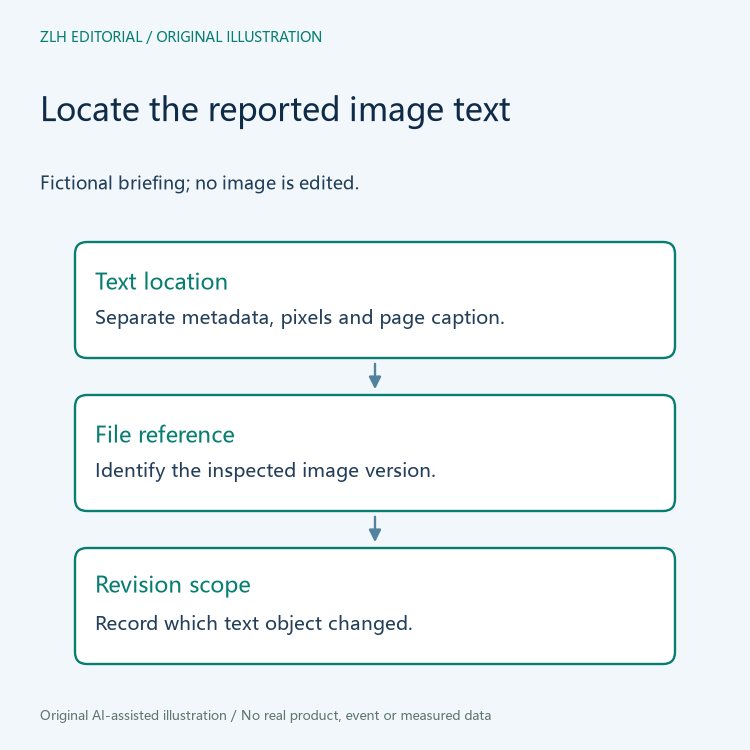
Imagine a fictional briefing image whose visible caption says Model preview, while a separate file-inspection note reports a description string. The reviewer should ask where each string came from. A person viewing the picture and a tool reading associated text can be describing different representations. The handover needs the actual image reference and the location of the reported text before it can explain a discrepancy.
Preserve the image version, any page caption and the provider's inspection explanation separately. A webpage caption outside the image is another object again. Do not assume that changing an image file's description will update the surrounding article, or that a visible label necessarily originated in metadata. The maintenance record should establish those relationships from the supplied materials rather than from the words' similarity.
Read textual chunks as associated information
The W3C PNG Third Edition Recommendation describes tEXt, zTXt and iTXt chunks for text strings associated with an image, with keywords indicating their role. It distinguishes those textual chunks from image data. The inspected Recommendation dates to June 2025; it is a format reference, not a new report that a particular additive briefing has changed or retained its labels.
For the fictional pack, ask whether the reported description was read from such a chunk and which keyword the provider supplied. The presence of a description string does not prove that a visible caption has the same wording. Nor does a metadata field prove that the described model or manufacturing event is real. It is a statement carried with a file and needs its own source and scope.
Read the library's text view as an inspection interface
The official Pillow PNG documentation explains that opening a PNG sets Image.text to a dictionary of values from its textual chunks. This describes a software interface for associated text. It does not identify words rendered into the image pixels, and the documentation is not a report that any particular briefing file has been opened or reviewed.
A fictional provider should identify the inspected file and the text information returned in its own record. Do not treat a manual's example or an attribute name as actual output. This article has read no image metadata and supplies no extracted strings claimed to belong to a project. The proposed maintenance question is whether the provider can connect its report to the correct image version.
Track each revised text object independently
Suppose a fictional editor revises a page caption while keeping the image unchanged. The maintenance note should describe that editorial object, rather than claiming the image pixels were updated. If the provider instead revises associated text in the file, record that object and the supplied version relationship. A third kind of change, redrawing a visible label, needs its own explanation. Similar wording does not collapse these actions into one.
None of those changes establishes the characteristics of a manufactured part. A visible label saying inspected is not an inspection record, and an associated description saying final is not manufacturing acceptance. The fictional briefing should retain any actual evidence separately. This article has no part, process observation or image revision result, so it makes no claim about production status or physical quality.

Write the maintenance finding around the text's location
A clear finding identifies the image file, the reported textual chunk information, any visible label reviewed and any separate page caption. It should say which objects were actually examined and which remain unexplained. If a later copy is supplied, retain its relation to the earlier version rather than assuming the same associated text survived every export or that visible words changed with it.
An annotated conceptual diagram can help show these locations, but it should not impersonate an inspected project screenshot. Mark the illustration as fictional and keep real extracted text in the relevant review record if it is eventually provided. The next reviewer then has a map of what to check instead of a single ambiguous note saying the image text was corrected.
Further methods appear in the technical material category and related resource category. These category entrances do not approve manufacturing images. Distinguishing associated PNG text, rendered labels and page captions makes the briefing's maintenance history more precise and keeps physical claims tied to the evidence they require.


