

3MF Handover Reading: Vertex and Property References
2026-11-04
3MF Handover Reading: Vertex and Property References
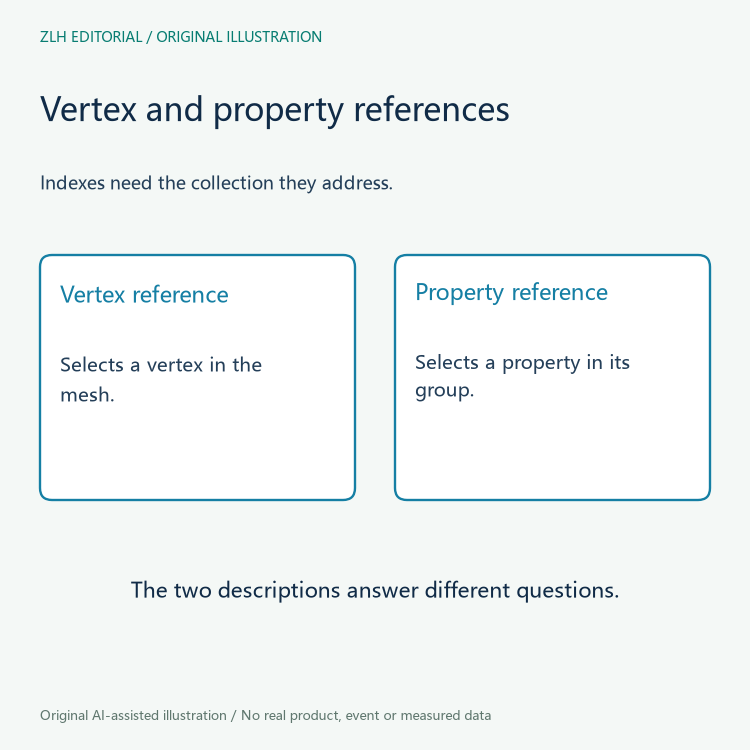
Property references and vertex references can appear beside one another in a 3MF triangle description, but they point to different kinds of information. A handover reviewer should not read a property index as another coordinate or assume that changing a property reference changes the mesh's vertex positions. This article examines official specification material and a fictional additive model pack. It does not edit a model, render a preview or manufacture a part.
Identify the element and the referenced collection
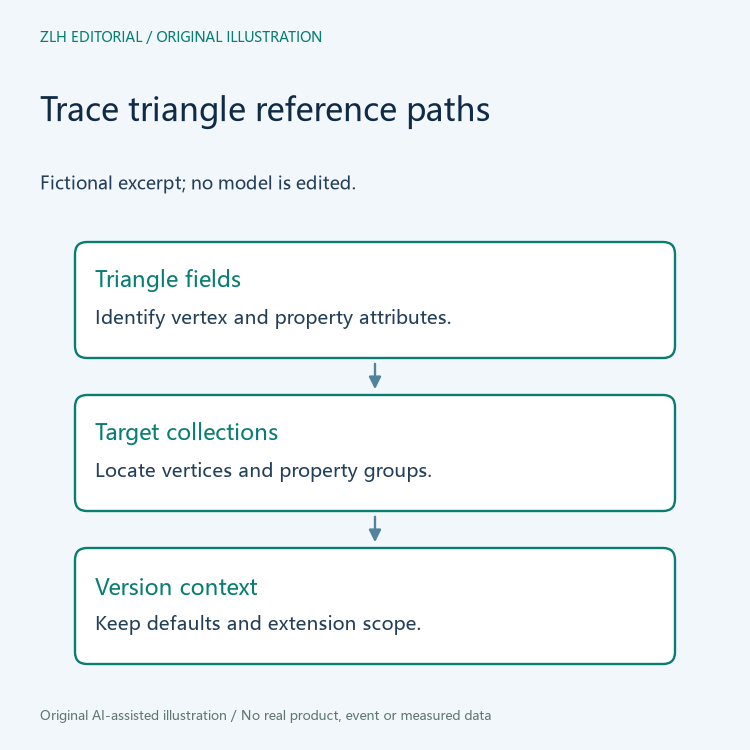
Imagine a fictional model excerpt with several compact attribute names on each triangle. The provider's summary calls all of them point numbers. That phrase loses an important distinction. The reviewer should ask which attributes identify mesh vertices and which concern properties applied at those vertices. Each reference needs the collection it addresses, rather than an interpretation based only on the fact that its value is an integer.
Register the exact model version, excerpt location and specification context. If only a screenshot is available, preserve that limit and request the relevant referenced definitions. A cropped triangle line can show an attribute without showing the resource it points to. The handover should not invent a property meaning from an adjacent colour in a preview or from the provider's informal choice of a friendly name.
Read vertex references as part of the mesh
The 3MF Consortium Core Specification 1.2.3 defines the triangle attributes v1, v2 and v3 as indexes into the mesh's vertices. It separately defines p1, p2, p3 and pid for property selection and overriding object-level defaults. These compact names therefore require different reference paths. The document does not turn a property index into a geometric coordinate.
For the fictional pack, the provider can identify the vertices collection used by a triangle and explain the property group associated with its property references. The reviewer need not execute a parser to recognise the documentation requirement. Do not copy a vertex lookup into a property explanation merely because the numeric values happen to be the same. Equal-looking indexes can belong to different collections and have different roles.
Read extension property groups in the declared version
The Materials and Properties Extension 1.2.1 describes additional resource groups and explains that a colour group's element order forms indexes referenced by objects and triangles. Its preface explicitly scopes the extension to Core 1.2. This article therefore uses the corresponding Core 1.2.3 document as a reading reference, not an assumed combination with a newer core specification.
The fictional handover should name the actual property group type and declared extension context. A colour group is not a universal interpretation for every property reference. If the provider uses another kind of property group, its explanation must follow that group's definitions. The reviewer should request the correct resource information instead of translating every property number into a colour label for convenience.
Preserve defaults and local overrides in the explanation
A triangle excerpt may not show every property setting in isolation. The provider should explain any relevant object-level default and any local override used in the delivered model. This is a documentary request, not a suggestion to fill in missing attributes. The reviewer must retain what the file actually declares and distinguish it from the explanatory mapping supplied with the handover.
Suppose a fictional revision changes a property group while leaving the mesh vertex definitions unchanged. The review should identify the changed reference relationship rather than announce a geometric redesign. Conversely, a geometry change needs its own account. This article has examined no model and reports no revision outcome; the scenario only shows why a handover should distinguish the kind of reference that was modified.
Accept a reference map without inventing a material result
A useful finding names the triangle fields, their referenced collections, the relevant defaults and the specification versions used for explanation. It should list unresolved resource references rather than silently assign plausible values. The finding concerns the model's documented structure. It does not establish the composition, strength, appearance or successful production of a physical part, all of which require evidence beyond a field mapping.
Retain a short annotated excerpt if it helps the next reader follow the references. Mark any invented illustration as fictional and avoid adding measured-looking material values. The reviewer should be able to trace each explanatory arrow to a named object in the supplied pack. If that object is absent, the diagram should preserve the unanswered question rather than supply a fabricated resource definition.
More reading methods appear in the technical material category and related resource category. These category entrances are not manufacturing approvals. Distinguishing mesh vertex selection from property selection makes the additive model handover more precise and gives later reviewers concrete places to check when an excerpt is unclear.


