

Additive Mesh Acceptance: Separate Shading from Geometry
2026-11-02
Additive Mesh Acceptance: Separate Shading from Geometry
Mesh shading can make an additive-manufacturing model look smoother without establishing a change in the underlying geometry. A buyer accepting a model presentation should ask what the supplier’s visual evidence is intended to demonstrate. A polished rendering and an examined mesh are related but different deliverables. This article proposes a presentation-review checklist. It opens no model, measures no surface, and approves no printed part.
Define the role of the model presentation
Ask whether the supplied material is an explanatory illustration, an editable mesh, or a representation used in another explicitly agreed task. The acceptance object should be named before the reviewer interprets a smooth-looking image as evidence about manufacturing geometry.
The handover should identify the source revision and the presentation that was actually reviewed. A rendering can communicate a design idea without exposing every mesh property. Keep the image’s explanatory role separate from any claim about the structure of the delivered model.
For the fictional review, no product shape or printer settings are supplied. Prepare questions about the model’s role and the evidence available. An invented smooth surface would add no meaningful information and could imply a result that no geometry review or printing trial established.

Read smooth shading as a presentation operation
The Blender shading manual explains that smoothing changes how shading is calculated across surfaces rather than modifying the object’s geometry. Its discussion distinguishes the visual impression from the mesh outline. That is a specific boundary the buyer should retain.
Ask the supplier whether the demonstration changed shading, geometry, or both. A before-and-after image should identify the operation actually performed. The receiver should not infer added geometric detail solely because lighting across the displayed surfaces appears smoother.
The official explanation concerns the documented software behavior. It is not evidence that a particular supplier model used that operation. A later authorized review needs the actual input, operation, and observation rather than a screenshot borrowed from a manual.
Keep normals and geometry descriptions attributable
The manual’s mesh structure discussion explains normals and their role in shading, including interpolation in smooth shading. This helps a reviewer ask which representation the supplier’s explanation concerns. A surface appearance alone does not identify every underlying mesh relationship.
Ask whether a supplied report describes visible shading, geometric elements, or another model property. Those terms should not be interchanged simply because they appear in the same modeling application. The buyer needs the scope of each statement to remain clear.
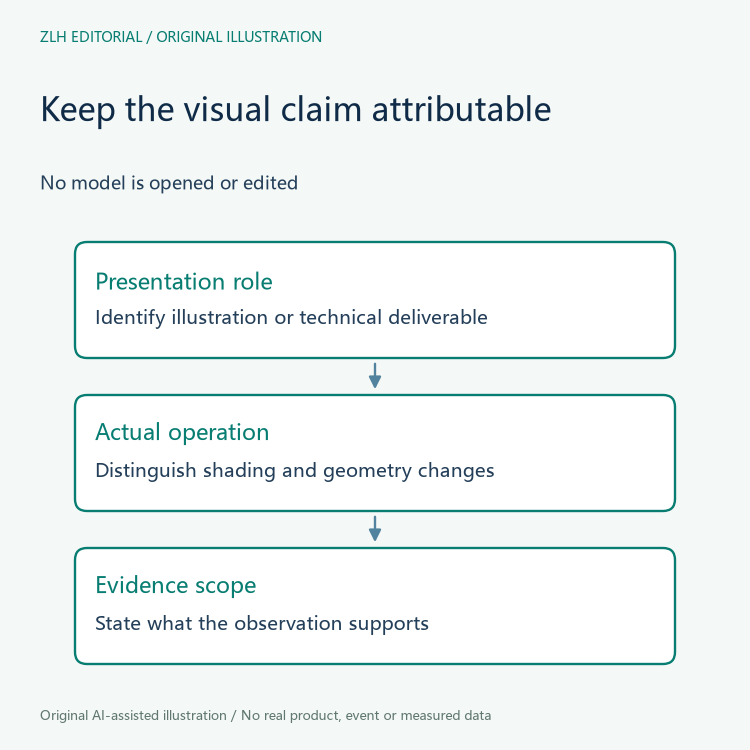
This checklist calculates no normals and inspects no mesh topology. It does not claim that a model is closed, manifold, dimensionally correct, or ready for production. Each of those would require an appropriate separate examination of the actual material.
Review the evidence supporting a visual comparison
A later comparison should identify the model revision and the presentation settings relevant to the stated question. Ask the supplier what remained unchanged and what was revised. Otherwise a visually improved image can conceal a different acceptance object.
Preserve the earlier presentation with its own context. Replacing an image and retaining an old success label can make it difficult to understand which representation was reviewed. An attributable revision is more useful than a gallery that implies every view carries the same evidence.
Keep printed-surface claims outside the rendering result
A smooth-looking model image does not establish the surface finish of a physical printed part. That claim needs actual part and measurement context. The editorial review should not turn a rendering setting into a production capability or inspection result.
Likewise, an intentionally faceted illustration is not by itself proof of a defective print or an unsuitable design. Ask what the representation was meant to communicate. The interpretation should follow the supplied evidence rather than a preference for a polished visual style.
Where the buyer needs a stronger conclusion, identify the missing evidence explicitly. The supplier can then answer the relevant geometry or manufacturing question. A presentation task should not be expanded by inference into an acceptance test that nobody agreed to perform.
Accept a model presentation with a bounded conclusion
The handover should distinguish the source model, shading explanation, actual observation, and any remaining geometry or production questions. A reviewer should be able to tell whether the result concerns communication quality or a separately examined technical property.
When the model or presentation changes, ask which earlier observations require renewal. Keep the review tied to its actual revision. A familiar image angle should not make a new model inherit an old conclusion without the appropriate check.
More notes appear in our additive model section and the reading directory. Both original illustrations organize review questions only, with no real mesh, rendered product, measured roughness, printer output, or completed manufacturing acceptance.


